Showing posts with label Stars. Show all posts

Thursday, June 18, 2009

Teaching the Solar System

We all grew up with a pretty simple idea of the solar system, right? There were nine planets moving in circles around the sun. Some were big and some were little but in the pictures they were all evenly spaced out and lined up. The problem is, it's not right. They aren't moving in circles (they move in ellipses), they aren't evenly spaced, and it turns out there aren't even nine of them! To top it all off, the solar system has parts most of us haven't even heard of.


Probably the first thing to learn is the distances involved. Distances in space are measured in two different ways. Outside the solar system, we measure the distance between stars in light years (how far light can travel in a year). But inside the solar system, that measurement is too big. It's like trying to measure how big your living room is by using miles. Instead, distances in the solar system are commonly measured in Astronomical Units (AU). An AU is simply the average distance between the Earth and the Sun. The sun is 1 AU from the earth.


A really good way to start learning how far apart things in space are is to map out the solar system. This is a super easy activity for parents, and it'll help your kids (and you) get a real grasp on what the solar system is actually like.


Here's what you need:


1. Planets. No, don't go out and buy styrofoam balls or anything. I've found that pictures work really well. You can order a really nice lithograph set from NASA... or you can just have your kids get out their crayons. Either way works great.
2. A long room or hallway. It needs to be at least 50 feet long.
3. string
4. tape
5. A way to measure the distances. A tape measure is fine (as long as it's a bigger one that will measure the entire 50 feet). Another easy way to measure it is to use a hallway in a public school. Most schools have linoleum tiles on the floor that are one foot squares. Just count the tiles to measure your distance.


And here's what you do:


Step 1.
Have your kids draw a picture of the sun and of each planet. It's OK if they don't know anything about the planets yet. This is part of how they learn. If they don't know any of the planets, tell them the names and let them use their imaginations. "Let's draw Jupiter! It's the biggest!" is fine. Don't worry about it if the planets are the wrong color or size. It'll be fine. Do be sure to include Pluto even though it's not a planet anymore. This is a great way to show how it's not like the other planets.


Step 2.
Have them tape the picture of the sun at one end of the hall. Then tell them to guess where the planet that's closest to the sun is. Have them tape Mercury on the wall where they think it belongs. Next comes Venus, then Earth, Mars, an Asteroid Belt (bet you didn't know we had one!), then Jupiter, Saturn, Uranus, Neptune, and Pluto. Most kids (and adults) will naturally space the picures out on the wall instead of clump them together.


Step 3.
Walk back over to the "Sun" and tell your kids that most people (even grown-ups) don't realize how far apart things really are in space. So you guys are going to re-hang their pictures but this time we'll see if we can get them the right distance apart. So you start measuring. And as you measure and move the pictures, you talk:


"Let's just pretend that the Earth is one foot away from the sun. So let's hang it's picture here... So every one foot is an Astronomical Unit. That sounds fancy, but it just means how far it is from the Sun to the Earth. Just like if we measured how far our house is from the road, we could call it a Yard Unit and measure everything that way. So... if the Earth is one AU (Astronomical Unit) from the Sun, then we need to fit a few other planets between the sun and the Earth."


Just talk them through the process of putting the pictures where they belong. Kids get a real kick when they realize that the first few planets are all scrunched together and the others get further and further away.


Here are the measurements for you:


As you rearrange the pictures, be sure to talk about how big each planet is. The sun is huge in comparison to everything else. If the Earth is the size of a marble, the sun is as big as a house. The entire wall that your picture of the sun is hanging on isn't large enough to put it in scale.

When you get to Pluto, there's a big "Huh???" moment. It has a range. So you stare at the wall a few minutes and talk about it. "It could be as close as this. But it could be as far as that!" Eventually, someone (maybe you) will decide to cut a hole in the picture and thread it on a string. Tape one end of the string to the wall at 30 feet from the sun, and the other end at 49 feet. Then the kids can slide Pluto around to all the places it could be. "Holy cow! It can be just as close as Neptune! It can even be a little closer? What the heck?" Want to get even stranger? It's orbit isn't level with the other planets. The other planets orbits are in a disc, kind of like the rings of Saturn. Pluto's orbit is tilted so that it goes above and below the disc. Plus there's a lot of debris in it's orbit. It still bumps into things as it travels around the sun. And it's a lot bumpier than the other planets. Those are the reasons it's no longer considered a planet. (For sentimental reasons I disagree and still count it as a planet, but it's definitely different from the others.)


Step 4.
So now you've hung all of your planets (+1 extra planet and a bonus asteroid belt) on the wall. What's next? The other stuff that you didn't know about.


Just after the planets there's a place called the Kuiper Belt. It overlaps the outermost planets and goes all the way out to 100 AU from the Sun. That's twice as far out as Pluto gets! The string it would take to show it's range is as big as the rest of the solar system. It also contains at least one dwarf planet - Pluto. Pluto is now considered to be a member of the Kuiper Belt - the largest object belonging to it, in fact! But it's not alone out there. There are comets and other icy rocks there, too. And there's more stuff beyond it. There's another dwarf planet calle Eris at 97 AU. It's right at the start of something called The Scattered Disc, which is just a big (huge!) disc with tiny icy planet-y rocks scattered in it. It goes out even further and has a bigger range.


And there might even be more. Scientists think there's something called an Oort Cloud, named for the guy that imagined it. (Imagination is good!) Scientists know that some comets travel far past the planets and even past the Scattered Disc. So we think those long-distance comets come from the Oort cloud that might be 50,000 or more AU from the Sun. Right now it's impossible to know because the comets move so fast and are so small. (Kind of like kids.)


If you were to draw a picture of the Oort cloud and hang it on a wall, it would be 9 and a half miles away. And the nearest star is 271,000 AU from here. That's fifty-one miles away from your picture of the sun!


So now you've taught your kids the basics of the planets. There's more... and it's way cool. But I'll have to dig it all up so it'll be a bit before I post it. If you have questions, let me know. And if you like what I wrote, please let your friends know and share my blog with them. I'm really enjoying meeting new folks via blogging.

Wednesday, March 25, 2009

For warm summer nights.


So it's been a while since I talked about astronomy here. I've been thinking about it, just not writing about it. But the nights are getting warmer and it's the right time of the year to be outside. So I think I'll just pick up where I left off. And that would be with M-17.

M-17 is a stellar nursery. You can tell by the lovely colors it's painted, and also by the dust. We mothers rarely have time to dust the nursery.
All kidding aside, M-17 is a nebula. It has a bunch of names including the Omega Nebula, the Swan Nebula, the Horseshoe Nebula, or the Lobster Nebula. I think it's interesting that it's called the Omega Nebula because Omega is the last letter in the greek alphabet and often used to mean the end or even death. But this nebula is actually a place of birth. It's one of the places stars are born, a.k.a. a stellar nursery. All that fluffy, billowy stuff that you see? It's dust. And in some areas the dust is thick enough that gravity is starting to pull it together into clumps. If the clump has enough mass to keep pulling in more dust and matter, then as it grows larger and more dense it will start to produce heat. If it can pull in enough gas and dust, the heat from all that matter being compressed will eventually ignite the gases and it will become a star.


Wednesday, March 11, 2009

Indigo Bunting


This little beauty is an Indigo Bunting. Right now, you couldn't find a one of his kind on my farm, but soon he and his friends will be traveling my way. Want to know the really cool part? He'll travel at night. Because Indigo Buntings use the stars to navigate during their migrations. And they aren't born with this skill hard-wired in. They learn it. If they've lived in captivity and couldn't see the night sky during the fall and spring, they aren't able to navigate. But if once they learn how to do it, they can find the way back to their favorite places from anywhere they wind up. How cool is that?

I also think it's neat that they aren't actually blue, or even indigo. The females are a dull brown and the males, like this one here, are black. Yup, black. Their feathers are black. But their feathers diffract light, kind of like a CD. If you hold a CD and look at it from the side, you can see that it's clear plastic. But the coating on it makes it diffract light so that it has that nifty rainbow look. The feathers on an indigo bunting are black. But the shape of the feathers causes light to diffract, making them look bright, vibrant blue. And the older the bird, the bluer his feathers look. Don't believe me? Check out the details here and here.

Wednesday, July 16, 2008

M-16, The Eagle Nebula

This is the M-16, the eagle nebula. It is a beautiful thing. I have a hard time thinking the universe was made by accident when I look at these pictures. When I look at these, I feel the same way I feel when I look at my kids, or really, any kids. I feel it was made with the utmost care and thought.

And this is a small part of it. Small being a relative term since they are light years tall. And if you're wondering how big that is, the earth is 8 light minutes from the sun. It's called the Pillars of Creation. Stars are born here. Or rather, they were. They were destroyed by a supernova about 7, 000 years ago. But we won't be able to see the blast for another thousand years.

And this bit is the Stellar Spire. Somehow it looks like it's moving to me. Spinning and dancing like a little girl. Maybe it is. You never know.


Tuesday, May 20, 2008

Shiny things.

All the breezy spring days lately have me thinking of warm summer nights out under the stars. So I decided to do another astronomy post. The first half of the Messier list is heavy on clusters, so I thought I'd skim through some more of those. So here are some shiny things you might like to take a look at this summer. Most of them I don't know much about other than their names. This is M-9, which is near the center of the Milky Way.

And this is M-10, and it's very close in the sky to M-12, so if you're looking at one, you can probably find the other easily.

This one is M-11, and is called the wild duck cluster. That's duck, with a D. I repeat, duck with a D. Get your mind out of the gutter.

This is M-12. It used to have a million more stars in it, but it lost them. They claim that the Milky Way stole them with it's gravity, but I'm not sure it didn't just set them down on the seat next to it in the restaurant and then forgot to pick them up when it left.

And this is M-13. In "The Sirens of Titan" Kurt Vonnegut wrote "Every passing hour brings the Solar System forty-three thousand miles closer to Globular Cluster M13 in Hercules -- and still there are some misfits who insist that there is no such thing as progress." -- And once, we sent a message there. It was in 1974 and was called the Arecibo message. It was really was pretty boring as such things go. We sent the numbers 1-10, the atomic numbers of the elements found in living organisms, and the most pitiful looking stick figure of a man you can imagine. And we aimed it at a planet that won't be there when the message arrives. Clearly it was done by committee.

This is M-14. In 1938, a nova appeared in this globular cluster, but nobody noticed it for almost thirty years. Then someone who was studying some old photographic plates from the thirties realized that there was a star in one of the pictures that was new. They think it was five times brighter than anything else in the cluster for a brief while.

and M-15, which I actually know a little about.


In the center M15 there are about 15 very hot stars isolated at the core. Scientists think they are the ‘naked cores' of stars that have been stripped of their outer envelope of gas. This could only have happened if stars were so crowded together in the cluster's core that their gravity pulled material from each other. They call it "stellar cannibalism", which kind of sounds like it's cannibalism done really well. Here's a picture, just so you know what a stellar cannibal looks like.

Saturday, April 19, 2008

M-7 and M-8


This is M-7, Ptolomy's Cluster. It's called that because Ptolomy described it in 130 A.D. He called it a nebula, but with a telescope you can see that it is made of stars. Nebulas also have dust and gases. They look like smudged sky.


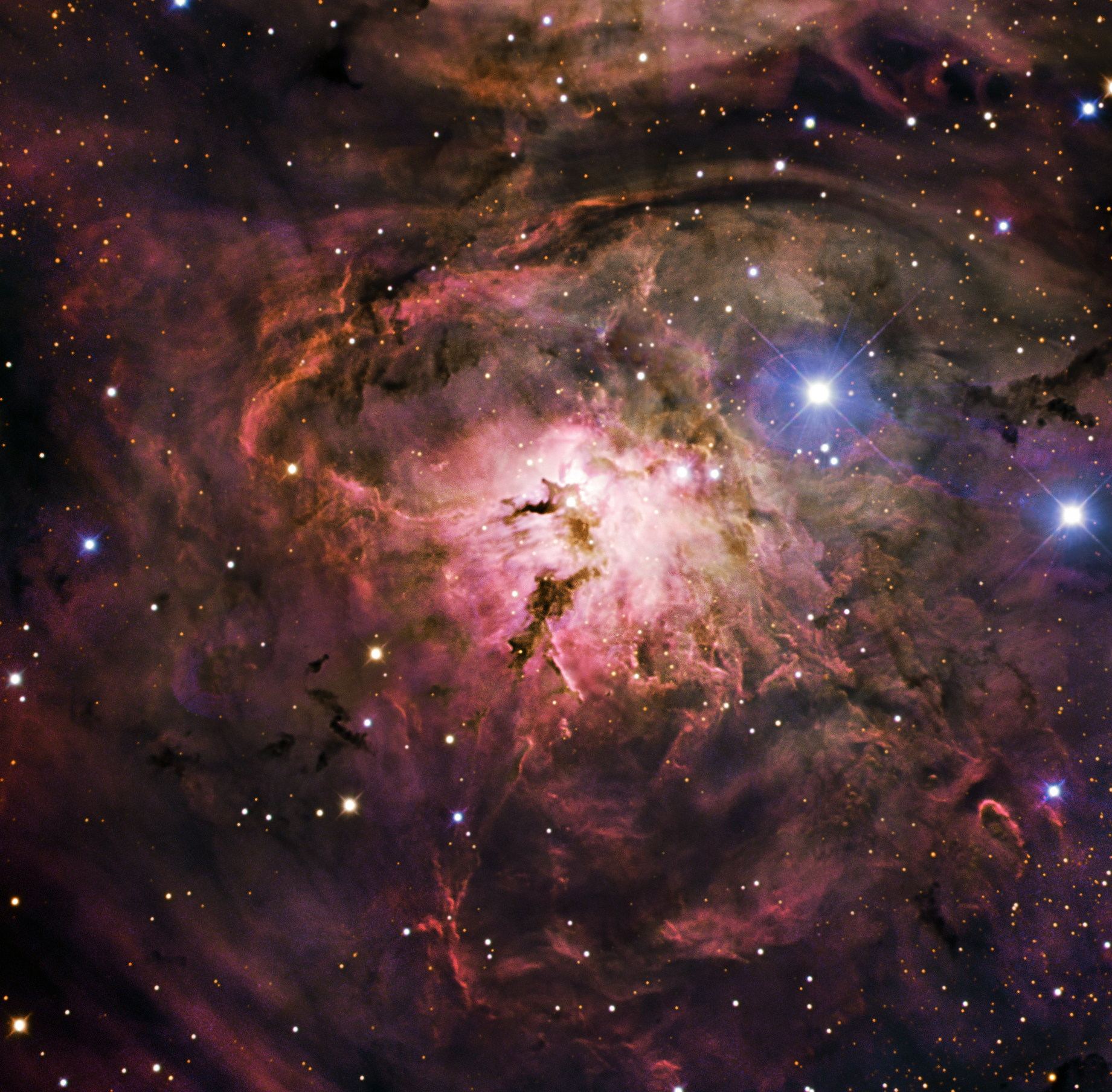
This is a nebula. Well, actually it's a nebula and a star cluster, too. There's an It's M-8, the Lagoon Nebula. It is visible to the naked eye... but it doesn't look like this. It just looks like a grey smudge. And in time lapse photos, it looks red. But Hubble makes some pretty pictures, and these two shots of it are beautiful. The colors are produced by using special filters on the image to show different gases as different colors.


This picture is also of M-8, and it shows how the gases are twisting and mixing. See how right where it's brightest, there are those shapes that look just like tornados? Those are tornados. Well, space tornados. That sounds really silly doesn't it? What's going on in the picture is that some areas of the nebula are hotter than others. The outsides of the clouds (where the light hits it) gets hot. The shaded interior stays cool. The difference in temperature means the same thing in outer space that it does on Earth. The gases shift around. So there's a wind. And tornados. Space tornados. And you thought this was gonna be boring!

Tuesday, April 1, 2008

M-4 again


Since all those star cluster pictures tend to look alike, I thought I'd check the Hubble Telescope website and see if there were some prettier ones to look at. I found a neat one of M-4 that I had seen before but forgotten about. It's a close up of one section of the cluster, and if you look close you'll see a green circle a little more than halfway up on the right edge of the picture. The first thing I thought when I first saw this picture several years ago was Wow, that green circle thingy doesn't even look natural. No, it's not a natural green circle in the middle of space. (Insert mental image of me blushing.) In reality, that circle was put there by a computer to mark a particular star on the picture. The star is a pulsar (I'll explain that some other time) and the reason they marked it was because it's orbited by the oldest planet known.

This is an even tighter close up of the same picture, just so you can see there's something in the circle.

Sunday, March 30, 2008

M-2 through 6: The Clusters

These pretty things are star clusters. I put them in order, just in case anyone should ever want to go outside and try to see one. You can look them up on wikipedia to find out which constellation to look in. Or just post here and I'll look them up for you. The first four (M-2, M-3, M-4, and M-5) are called Globular Clusters. That's just a fancy way of saying that they large dense groups of stars which orbit the core of a galaxy.


This first picture of M-2 doesn't look like much. But it's got 150,000 stars in it. The light from there takes 36,000 years to get here. And of course the light from here takes the same amount of time to get there. So if someone there is looking at Earth, they'd be seeing Cro-magnon men. But they'd better have a darn good telescope.


This one is M-3. It has half a million stars in it. I know. I counted them last Saturday. It took up the whole afternoon.


M4 looks like a fuzzy ball of light in even a small telescope, and in bigger ones you can see that it's made of stars. It was the first globular cluster that they were able to see individual stars in, and now they've even managed to find a planet in it.


This one is M-5. (How did you guess?) It's one of the biggest and oldest of the globular clusters. It's 13 billion years old, which is about three times as old as the Earth. And before anyone gets all over me for religious reasons, let us not forget... In the beginning God created the heaven and the earth. And the earth had no form.
M-6 is a galactic, or open cluster. Open clusters are made from only a few thousand stars that were all formed at the same time. It's about 2,000 light-years from Earth, so this is what it was like when Jesus was walking the Earth. It's mostly made of blue and white stars with the brightest being a yellow or orange giant. Some people call it the Butterfly Cluster, but it doen't look like a butterfly to me. Maybe the guy who first discovered it had a little girl with him.

Well, it's too cloudy to see the stars tonight, but not too cloudy to do the dishes. So I'm off to work on the other Messier stuff. Good night.

Wednesday, March 26, 2008

M-1 Crab Nebula


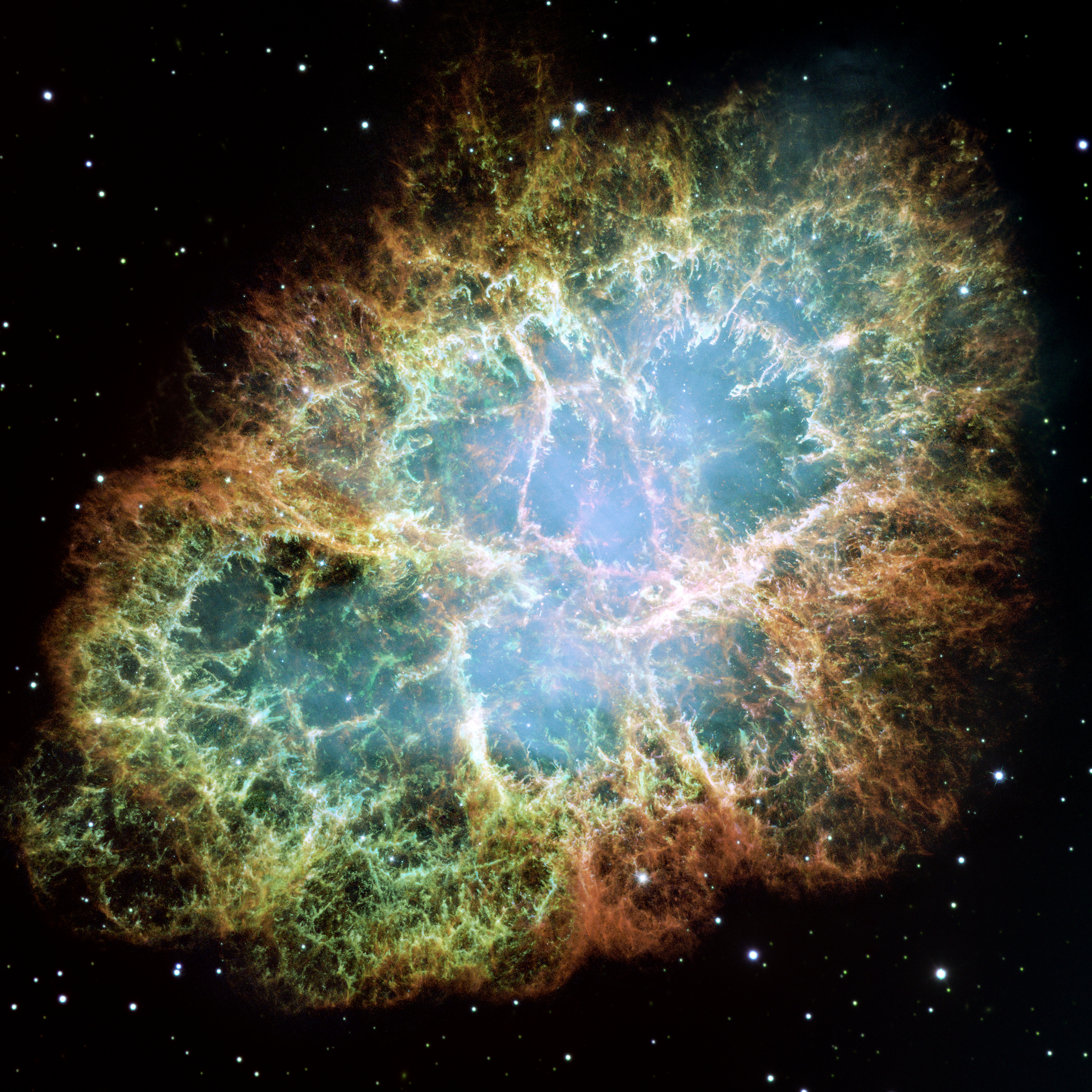
Since I said I'd be blogging about things that interest me, I thought I'd start with some of the astro- nomical Messier Objects. No, I'm not an expert. I can hardly find these things at night. But I like to try from time to time. This is M-1 (short for Messier-1) and it's the Crab Nebula. It's the remains of a supernova. Think the debris from a large explosion, the dust hanging in the air, only bigger than a planet. Bigger than the solar system. If you want to see it, look in the constellation Taurus. It amazes me when I think about the fact that humans saw the supernova that created this nebula. It wasn't even that long ago - 1054, when they were busy building castles and having crusades in Europe. The light from it was so bright that the only thing in the night sky that was brighter was the moon. Of course, they didn't see it as it was happening. The thing about astronomy is that there's a time delay. You're watching what happened year ago, or hundreds of years ago, or thousands. This photo is borrowed from Wikipedia by the way, and of course they borrowed it from NASA. It was taken by the Hubble telescope, and it looks much, much better than what I see when I use my Wal-mart binoculars. But then again my binoculars only cost me $5.

I had planned to put some family pictures on tonight. But I'm feeling a little like going outside and seeing if the stars are out. It was a beautiful sunny and warm day, and soon the evenings will be just right for camping out or building a fire. I think I'd better go enjoy it while it lasts.

Messier Objects

I was considering what to name this blog, and I decided to go tongue in cheek on this and call it Messier Objects. For those of you who aren't astronomy buffs, the Messier Objects are a group of galaxies, nebulae, star clusters, etc. that are easily visible from the northern hemisphere using binoculars. (Named after Charles Messier, the French comet-hunter who felt all these shiny things which do not move were annoying.) My Messier Objects are shiny (and sometimes annoying), but do move quite a bit. They are my four kids who keep me so busy that I only get time to myself at night, when I could be outside with binoculars looking for galaxies, etc, but am too tired from cleaning the Mess.

I'll tell you all about us and start putting pictures and stories and all the interesting stuff on here tomorrow or the next day. But in the mean time, I'm going to consider it quite the accomplishment to have started this in the first place.

Have a happy night. I hope you enjoy it.

Karen